

Key takeaways
Reconstruct a bounded piece of work from actual cases. Procedures, interviews, observation and system records reveal different parts of it.
Separate missing information from uncertain judgment and missing authority. Each calls for a different change.
Compare task automation with removing a handoff, improving data access or simplifying a rule. AI may help with only part of the redesigned workflow.
Specify what people receive at a handoff, what they may decide and what happens when they cannot resolve the case. Plan for the work and learning opportunities that remain.
An invoice clerk can find the purchase order, read the supplier’s explanation and draft a convincing account of a discrepancy. The invoice may still be unpayable. Someone must establish whether the goods arrived, decide which record needs correcting and have permission to make that correction. Making the explanation faster leaves those dependencies intact.
This is the problem with treating an existing task description as the specification for AI. A task such as “resolve invoice discrepancy” can include retrieving records, interpreting evidence, negotiating a correction and exercising delegated authority. Different people may perform those activities, sometimes through arrangements absent from the procedure.
Workflow redesign starts by reconstructing those arrangements. The aim is to decide which work to keep, remove or change before deciding how much to delegate to software. A bounded invoice example will show how to investigate the current arrangement, compare alternatives and specify human/software handoffs. The proposed redesign is a design argument, not a report of measured improvement.
Bound the workflow around an obligation
Hypothetical example. A company receives an invoice for 100 units against a purchase order for 100. Its purchasing system records receipt of 80. Assume this business unit requires receipt confirmation for the billed quantity and permits no quantity variance on this order. Invoice validation places a quantity hold. All quantities, roles and local policies in this example are invented.
Define the workflow from detection of that discrepancy to a recorded disposition. Record whether the discrepancy led to corrected receipt evidence and renewed validation, a supplier credit and corrected invoice, or a dispute assigned to an owner. A dispute remains open work until settlement. A completed summary does not discharge the obligation.
In the existing arrangement, accounts payable opens a spreadsheet entry, copies the invoice and purchase-order details, and emails the buyer. The buyer asks the receiving team about the missing units. Accounts payable chases the buyer and updates the spreadsheet. A finance approver reviews the explanation before accounts payable resubmits the invoice for validation. Payment execution is outside this example.
The ordinary correction is straightforward. The receiving team confirms that the remaining goods arrived but were not recorded, enters the receipt through its authorized process, and accounts payable reruns validation. If the remaining goods never arrived and the supplier agrees, the supplier issues a credit that reduces the billed quantity for the affected line by 20 units. Accounts payable records the quantity correction, and validation runs again. Other holds can still prevent payment.
The mechanism resembles documented practice. Oracle’s invoice-validation documentation describes quantity and price discrepancies, correction and revalidation. Its hold documentation also permits manual release for some hold types. The hypothetical company’s stricter rule is a local design choice, not a universal accounting requirement or a claim about Oracle defaults. Oracle, How Invoices Are Validated; Types of Holds; Quantity-correction FAQ, p. 125.
Reconstruct cases using sources that can disagree
Begin with a resolved discrepancy and follow it backward through the records and people involved. Then examine a case that took another route, an unresolved case and a case that someone reopened. This is a practical starting sample, not a claim of statistical coverage. Include the staff who inherit incomplete work, rather than interviewing only the process owner.
Each source answers different questions:
Procedures identify required evidence, assigned roles and stated controls. They may describe an earlier system or omit how workers choose among permitted actions.
Interviews elicit reasons, local vocabulary, disputed responsibilities and cases worth examining. Recall and incentives shape the account. Ask the worker to show a particular case rather than describe an ideal sequence.
Observation reveals interruptions, consultations and judgments made while work happens. A short observation period misses rare events, and being observed can change behavior.
Event logs show recorded transitions and times. Establish whether a timestamp means arrival, entry or later synchronization. An interval between events can include waiting, active work or an unrecorded conversation.
Process mining uses event data to reconstruct paths or compare recorded behavior with a model. It can reveal repeated loops and variants across more cases than direct observation, but depends on how events are linked and recorded.
The Process Mining Manifesto treats event quality as foundational and warns that recorded traces are incomplete samples of possible behavior. Its discussion of merging data also addresses events associated with several business objects. An invoice can span purchase-order lines and receipts; choosing the invoice header as the sole case identifier can conceal that structure. IEEE Task Force on Process Mining, Process Mining Manifesto.
Reconcile disagreements before drawing a clean sequence. Suppose the procedure assigns receipt questions to the buyer, but the buyer forwards every question to receiving. Observation shows that accounts payable already knows which receiving clerk handles each site. The buyer’s step might contribute commercial judgment, or it might merely forward messages. Inspect the cases to distinguish those functions.
This concern predates AI. Lucy Suchman’s 1983 study used recorded office conversations to examine an accounts-payable auditing procedure and the evidence workers assembled from documents and other people. It offers a detailed case, not an estimate of how often procedures omit work today. Office Procedure as Practical Action.
Keep a concise record of what remains uncertain. “Receiving confirmed delivery by phone; no receipt entered” records a disagreement between evidence sources. Replacing it with “delivery confirmed” would erase the next person’s reason to investigate.
Distinguish tacit judgment from unavailable information
When an experienced clerk says that an invoice “doesn’t look right,” ask what they inspect next. They may recognize a supplier’s reused invoice number, know that a particular site enters receipts late, or notice a unit-price pattern associated with cases rather than individual items. Following the next action can expose cues that a general interview misses.
Some discoveries are information problems. A case-to-unit conversion can be defined in master data. A receiving clerk’s site assignment can be maintained in a directory. Other discoveries involve judgment, such as deciding whether conflicting delivery evidence warrants a supplier dispute. A description of the judgment may help another worker without becoming a complete decision rule.
Tacit knowledge also does not establish a permanent limit on AI. In Generative AI at Work, Brynjolfsson, Li and Raymond studied a staggered assistant rollout among 5,172 customer-support workers. Less experienced and lower-skilled workers benefited more, and the authors found suggestive evidence of convergence in communication patterns. Workers retained discretion over suggestions. That supports the possibility of conveying some expertise through assistance, within that setting; it does not establish autonomous invoice-resolution capability. Generative AI at Work, revised working paper.
For the invoice redesign, retain examples of the cues people used, the evidence they sought and the alternatives they rejected. Mark where the account remains incomplete. Do not treat a well-written explanation as proof that all relevant knowledge has been captured, or treat an unexplained intuition as proof that the task must remain unchanged.
Compare automation with removing or changing work
Consider the alternatives separately before combining them into a redesign.
Automating the existing email task would let software retrieve the discrepancy and draft a request to the buyer. The same buyer-to-receiving dependency would remain. That may help if writing and retrieval consume effort, but it would leave the forwarding and chasing work in place.
Improving data access could let accounts payable see receipt status without asking the buyer. The necessary change would be an authorized view of purchasing and receiving records. Conventional integration may be sufficient. A model cannot compensate reliably for a missing record of physical delivery.
Removing the forwarding handoff would route missing-receipt questions directly to receiving. Keep the buyer involved when price, contractual terms or a supplier disagreement requires commercial judgment. This changes the allocation of work. It requires receiving to accept the queue, rather than simply changing the recipient on an automated email.
Simplifying a rule could remove a redundant approval. In this hypothetical arrangement, suppose case review establishes that finance routinely repeats the same quantity comparison after an authorized receipt correction, without making another decision. The process owner could propose removing that repeat check for this case class. Finance must confirm that the step supplies no separate control before approving the change. A model’s confidence is no basis for relaxing the receipt requirement.
AI assistance has a narrower proposed role. It could summarize a long supplier correspondence, identify conflicting explanations and draft an evidence request for staff review. Structured quantity comparisons, routing by an approved site directory and enforcing permissions belong in conventional software. An agent that chooses retrieval steps would need an additional justification if the sources and sequence are already known.
Hypothetical responsibility comparison. The proposal changes who assembles evidence and who receives missing-receipt work. It preserves the authority to attest receipt and change commercial terms.
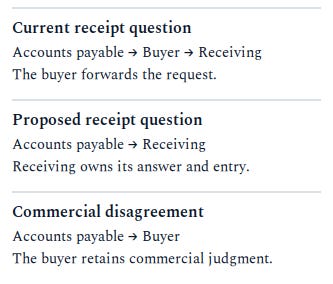
Figure 1. The proposed missing-receipt route sends the question directly to receiving. The buyer remains responsible for commercial disputes. Removing a forwarding step changes work allocation; it does not establish a saving or change receipt-entry authority.
Assemble evidence
Existing arrangement: Accounts payable copies records
Proposed arrangement: Software retrieves linked records; AI may draft a cited summary
Confirm missing receipt
Existing arrangement: Buyer forwards questions to receiving
Proposed arrangement: Receiving owns the receipt question and authorized entry
Resolve commercial dispute
Existing arrangement: Buyer investigates after email referral
Proposed arrangement: Buyer receives cases needing commercial judgment
Resolve quantity hold
Existing arrangement: Finance repeats comparison; accounts payable revalidates
Proposed arrangement: Approved rule removes duplicate review; accounts payable revalidates
Each alternative needs evidence for its proposed change. Removing a handoff depends on knowing what it contributes. Removing an approval depends on its control purpose. Adding AI depends on whether its assistance improves the retained task.
Compare feasible alternatives on the same class of cases and required dispositions. Include investigation, review and chasing across all affected roles, delays and unresolved work, control consequences, and the effort to introduce and maintain each arrangement. Separate differences observed in cases from assumptions about the proposed workflow. If retrieval and drafting consume substantial effort while changing responsibilities is currently infeasible, assistance within the existing arrangement may be a reasonable first change.
Specify the evidence and authority at each handoff
The proposed workflow creates a shared discrepancy record instead of maintaining a spreadsheet and disconnected forwarding chain. Each record identifies the invoice line, purchase-order line, supplier, business unit, receipts, the continuing discrepancy owner and the assignee of the next action. Accounts payable remains responsible for the unresolved discrepancy while receiving investigates a receipt question or the buyer handles a commercial dispute. Routing changes the next-action assignment without transferring that continuing responsibility.
The redesign must define whether quantities represent units or cases, whether receipt means physical arrival or accepted goods, and how reversals and credits affect the balance. Otherwise a correct comparison of incompatible fields can produce the wrong instruction.
Local variation needs an explicit boundary. One site may require inspection acceptance before payment eligibility; another may use receipt alone. Route according to the applicable approved rule. Do not infer permission from whichever site has the most historical examples.
Software retrieves records within its authorized business unit and prepares the missing-evidence request. An AI summary points to the correspondence passages it uses and separates supplier statements from system records. Read access to those materials grants no right to enter a receipt, change a purchase order or release a hold. Receiving retains receipt-entry authority; the buyer retains authority over commercial changes. The software account lacks those write permissions.
At a site requiring inspection acceptance, suppose the supplier says the remaining 20 units were delivered, and receiving confirms arrival but reports damage and refuses acceptance. The summary must preserve both delivery and nonacceptance, along with any dispute about the remedy. The acceptance requirement for payment eligibility remains unmet. Receiving investigates the goods; the buyer handles the supplier dispute; accounts payable retains ownership of the invoice’s open status. No generated explanation closes the discrepancy. A request containing changed bank details belongs to a separate supplier-verification process and cannot be resolved through this queue.
At the human handoff, supply the original evidence, the discrepancy, actions already taken and the decision requested. Name the recipient’s authority and the destination for a rejected or inconclusive case. In this proposal, receiving gets a receipt question, not a generic instruction to “approve the AI.” If receiving cannot determine what arrived, accounts payable keeps responsibility for the open discrepancy, keeps the invoice on hold and assigns the next investigation action to a named person or team.
Specify time as well as role. The process owner sets a response window and escalation route before the queue starts. Accounts payable monitors overdue items and invokes that route. An absent approver cannot be treated as consent. If a receipt or invoice changes during review, the workflow checks the current record before revalidation and returns material conflicts for review.
The specification should also name who can stop the automated intake or return cases to manual handling when retrieval fails. Accounts payable needs access to the evidence and pending queue during that interruption. A fallback that depends on the unavailable summary service would leave the same work inaccessible.
Design the human work that remains
The redesigned receiving queue creates a staffing obligation. Removing the buyer’s forwarding step does not establish that receiving has time to investigate discrepancies. Accounts payable may spend less time copying records while receiving handles a more visible workload. Review both teams’ responsibilities before treating the change as a saving.
Incentives can change the recorded process too. If accounts payable is rewarded only for closing cases, and receiving only for throughput, both teams may have reasons to avoid a disputed invoice. In this example, distinguish a routed case, an awaiting-response case and a resolved discrepancy. Give the next-action assignee a way to challenge a mistaken assignment while accounts payable keeps the discrepancy visible as pending work.
Expertise requires attention after routine tasks move to software. Bainbridge’s Ironies of Automation describes how automation can leave operators with difficult abnormal situations while reducing opportunities to exercise the skills needed for intervention. It concerns industrial control, not an observed outcome of today’s invoice agents. Ironies of Automation.
For this proposal, use periodic joint case review and supervised investigation to preserve familiarity with the records and decisions. That is a design recommendation, not a demonstrated cure for skill loss. AI assistance might also help staff learn; whether the new arrangement does so depends on the work people actually perform and the feedback they receive.
Before building, walk a resolved case and a disputed case through the proposed arrangement with the people who would do the work. Require each participant to show the evidence available, the permitted action, its assignee and the continuing discrepancy owner. If receiving cannot accept the queue or finance cannot explain the proposed approval removal, revise the allocation first. The resulting specification should make the changed work understandable even with the AI component switched off.